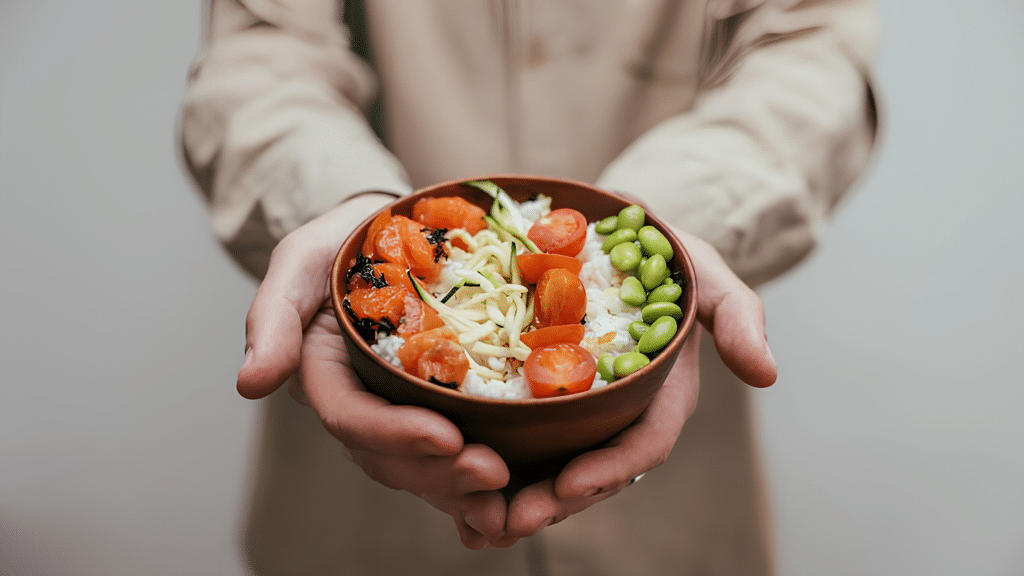
Most conversations about food and health start in the wrong place.
They start with what to eat, when to eat, how much to eat — the rules, the protocols, the lists. And while those things have their place, they miss something more fundamental: the relationship between food and the body is not primarily mechanical. It is energetic. It is informational. And it is deeply personal.
Food is not just fuel. It is the most direct and constant conversation your body has with the external world. Every meal is a set of instructions — to your cells, your hormones, your nervous system, your immune response. The question is not just whether you are eating healthily. It is whether the food you eat is delivering the information your particular body needs, at this particular stage of your life.
Every meal is a set of instructions to your cells, your hormones, your nervous system, your immune response. The question is whether the food you eat is delivering the information your body needs.
The Singapore Context
Living in Singapore gives us extraordinary access to some of the most nutrient-dense food in the world — fresh seafood, a remarkable diversity of vegetables and herbs, traditional preparations that have sustained populations for generations. It also puts us within easy reach of some of the most nutritionally depleted food available anywhere: ultra-processed, high-sugar, refined-carbohydrate options that are cheap, convenient, and genuinely enjoyable in the short term.
The pace of life here does not make mindful eating easy. Meals are often rushed, eaten at desks or between meetings, chosen for speed rather than nourishment. This is not a moral failing. It is a structural reality. But it is worth naming, because the cumulative effect of eating under stress — regardless of what you are eating — affects how well your body can actually absorb and use the nutrients you are consuming.
Eating for Energy: What Actually Works
There is no single diet that is right for every person. The evidence for this is robust and growing — individual variation in gut microbiome composition, genetic differences in nutrient metabolism, and the role of stress and sleep in affecting how we process food all mean that what works brilliantly for one person may be actively unhelpful for another.
That said, there are principles that hold broadly across the research:
Whole, minimally processed foods provide the full complexity of nutrients, fibre, and phytochemicals that refined versions lack.
Anti-inflammatory eating — centred on vegetables, good fats, quality protein, and minimal sugar and refined carbohydrate — reduces the chronic low-grade inflammation that underlies so many modern health complaints.
Eating slowly and without distraction activates the parasympathetic nervous system, which is where digestion actually happens. Eating under stress, even the healthiest food, is absorbed less effectively.
Hydration is underrated. Even mild dehydration affects cognitive function, mood, and energy levels in ways most people attribute to other causes.
Timing matters more than we used to think. The research on chrono-nutrition — eating in alignment with your body’s natural circadian rhythms — suggests that when you eat affects your metabolic response as much as what you eat.
Food and Emotional Life
One of the most important and least discussed aspects of mindful eating is the emotional dimension. We eat for comfort, for connection, for celebration, for relief from boredom or stress. This is not a problem to be solved — it is part of what makes us human.
What becomes problematic is when food is the primary or only tool for emotional regulation. When the relationship between eating and emotional state is largely unconscious. When certain foods are used to numb rather than nourish.
Understanding your own patterns around food — without judgment, simply with curiosity — is often one of the most illuminating things you can do for your overall health. Not because eating is a moral issue, but because it is such a direct window into what your body and your emotional system are asking for.
A simple practice to start:
Before your next meal, take three slow breaths. Put away your phone. Eat without reading or watching anything for just five minutes.
This is not a rule. It is an experiment. Notice what is different — in how the food tastes, in how you feel during and after the meal. The body gives very clear feedback when we are quiet enough to hear it.
Food is not a punishment, and it is not a performance. At its best, it is one of the most consistent and accessible forms of care we can offer ourselves — three times a day, every day, for the rest of our lives.
That is worth paying attention to.
Want to explore what nutritional support could look like for your specific situation?
A discovery conversation is the right place to start — to understand what your body
might actually be asking for.